

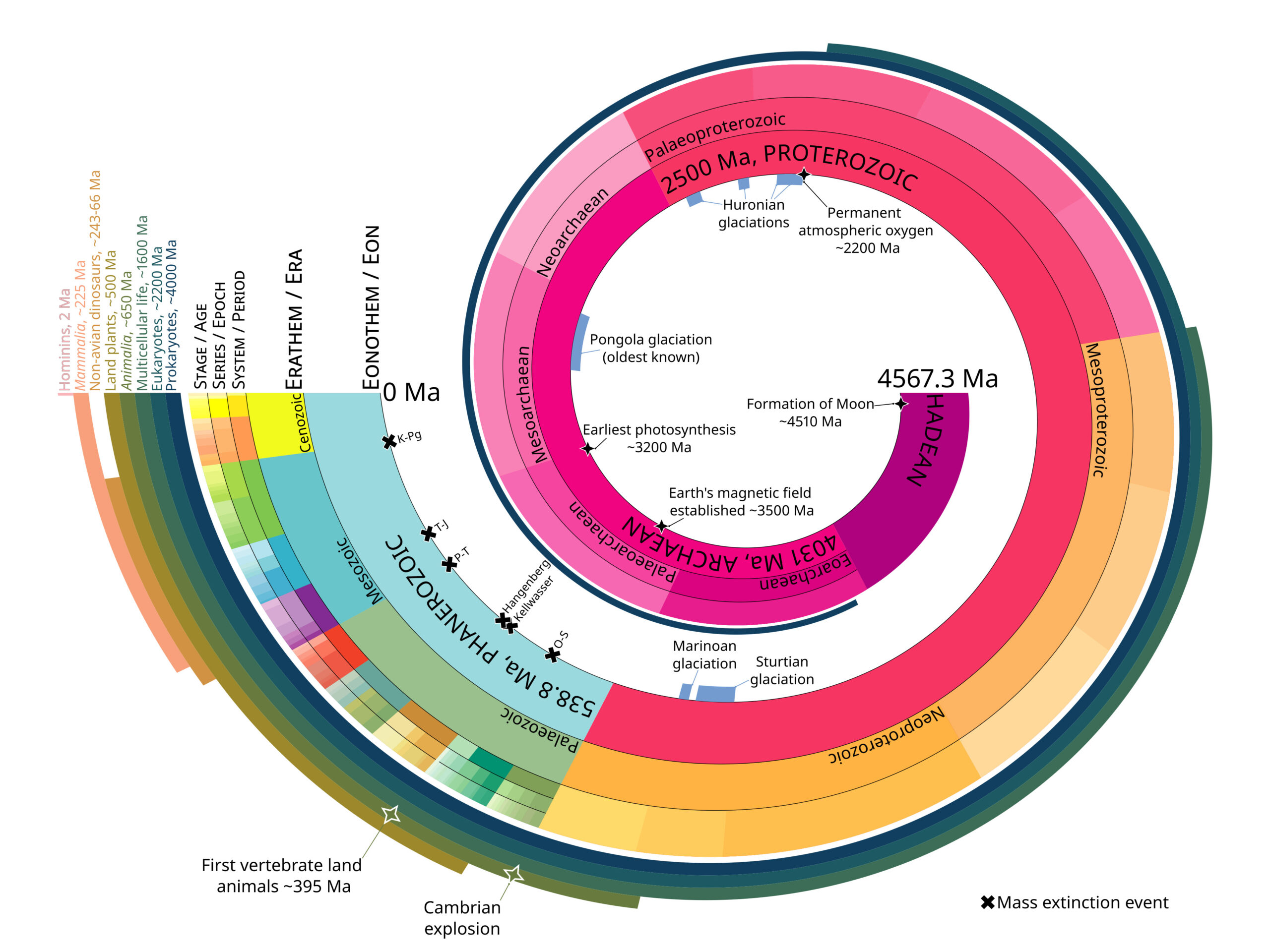
A common trope in science fiction and fantasy is that of a long-lived being, like the Elves Galadriel and Elrond in J.R.R. Tolkien’s The Lord of the Rings, or the Time Lord the Doctor in BBC’s Doctor Who. These beings often engage with mortal Men or humans who, in comparison, live vanishingly short lifetimes that are portrayed as tragic to these long-lived beings. To a human, a century is a long time, and we are best equipped to think on decadal or generational time scales. To the long-lived Elves and Time Lords, their lives are lived on the time scales of centuries or millennia, a time scale that their human companions cannot comprehend. And still these immortal-like beings would probably struggle to conceptualize geologic time.
Geologists have unique training that enables them to begin to imagine geologic time. To a geologist, a million years is a “short” amount of time. Ten, or even fifty thousand years, is incredibly small. As geologists living amongst the rest of the world, we are often met with bafflement when we consider the span of human civilization to be near-instantaneous. In order to bring readers closer into understanding the vastness of geologic time, I present the reader with an apt analogy that has come to be known as the “Geologic Calendar”, which uses a unit of time that the average person can readily comprehend: a calendar year.
If we were to condense the entire life of planet Earth into a single calendar year, we would assume that the Earth condensed out of the spinning solar dust formed by a nearby supernova into a molten ball of rock in the opening seconds of January 1st, approximately 4.6 Ga (the abbreviation for Giga-annum, literally, a billion years). The oldest known Earth rocks, the Acasta Gneiss (dated to 4.03 Ga) would not form until February 13th– nearly a month and a half later!

The first recorded forms of life, cyanobacterial mats known as stromatolites, do not appear in the Geologic Calendar until March 27th (approximately 3.8 Ga, although this date is disputed). The first eukaryotes– cells with nuclei, like yours, mine, and amaeobas– do not appear until July 17th (approximately 2.2 Ga). There is a whole period of geologic time, 1.8 to 0.8 Ga, colloquially called the “Boring Billion” in which the climate was relatively static, the earth was tectonically stable, and biological evolution moved extremely slowly. Imagine an empty calendar from August through October! In comparison, the “Cambrian Explosion”, which is what geologists call the massive diversification of multicellular organisms that are indisputably animals, would not occur until November 19th. The time period spanning from the Cambrian Explosion to today, called the Phanerozoic (literally, “visible life”) is what the vast majority of geologists and paleontologists research, and it barely encompasses more than a month of the Geologic Calendar.
From November 19th onwards, the calendar is jam-packed with events: animals move onto land November 23rd. On November 26th, the first of the Big Five mass extinctions occurs at the end of the Ordovician, ~443 Ma (the abbreviation for Mega-annum, a million years), followed by the second on December 3rd (end Devonian, ~360 Ma). The Earth’s worst mass extinction, in which 90% of marine species went extinct, occurs December 12th. Between December 12th and 15th, both dinosaurs and mammals appear, although dinosaurs become the dominant species. Their period of dominance on this planet, while encompassing nearly 177 million years, is short-lived in our Geologic Calendar analogy. Their mass extinction, the most famous of the Big Five, occurs on December 26th. From here on out, mammals are the dominant terrestrial vertebrates. Finally, humans do not appear until December 31st, New Year’s Eve. The first hominids appear around 6 pm, but anatomically-modern Homo sapiens do not appear at 11:38 pm. Lastly, the entire history of human civilization occurs in the final minute of the Geologic Calendar.
Much like the trope that opened this blog post, all of humanity has lived merely evanescent seconds compared to the vast life-span of the Earth’s. The speed with which humans have altered climates, ecosystems, and rendered organisms extinct should be terrifying.
-Dr. Margot D. Nelson