

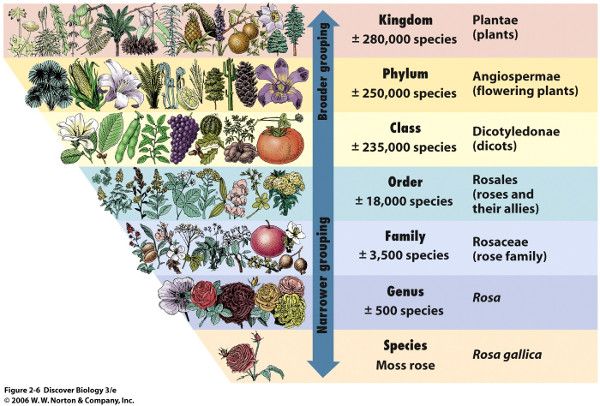
Taxonomy, put very simply, is the combination of practice and science of categorization of things— for biologists, taxonomy is specifically the classification of organisms into a framework that reflects the relative recency of a common ancestor. While taxonomy has been practiced since ancient times, biologists recognize a couple watershed publications by the Swedish scientist Carolus Linnaeus: Species Plantarum in 1753 for botanical nomenclature, and Systema Naturae 10th Edition in 1758 for zoological nomenclature. Linnaeus developed a classification into which each organism would be placed into a kingdom, a phylum, a class, an order, a family, a genus, and finally a species. This structure is hierarchical, meaning that each smaller taxonomic group nests within a larger one. A species is given a binomial name, meaning it has two parts: the genus name, and a specific epithet. Both are needed to properly express the name of an organism.
Let’s take the example of the domestic cat: the cat belongs to the Kingdom Animalia, within which the phylum Chordata is nested. Inside phylum Chordata, you have the Class Mammalia, which contains the order Carnivora. The cat is within the family Felidae; its scientific name is Felis catus– meaning that the cat is within the genus Felis with the specific epithet of “catus”. Everything in the genus Felis is more closely related to the cat than other genera in the family Felidae. Likewise, everything in the family Felidae shares a more recent common ancestor than to any other family within the Carnivora.
Taxonomy is either a subset of, or closely related to, the study of systematics. Systematics is the study of the diversification of life throughout evolutionary history, and the evolutionary relationships between organisms throughout time. In my scientific opinion, taxonomy is a subset of systematics given that, without names and classification, we have no way to understand diversification or evolutionary relationships, especially when potentially millions of species remain undiscovered both today and within the fossil record. By modern standards, it has become rather unacceptable within vertebrate paleontology to publish a new species without review of its role in systematics. I personally like the definition by Michener et al. (1970) which treats taxonomy as a part of systematics and notes the important role of curation:
“Systematic biology (hereafter called simply systematics) is the field that (a) provides scientific names for organisms, (b) describes them, (c) preserves collections of them, (d) provides classifications for the organisms, keys for their identification, and data on their distributions, (e) investigates their evolutionary histories, and (f) considers their environmental adaptations.”
When most people think of paleontologists finding new species, they imagine a paleontologist out in the field finding something brand new while prospecting and digging it out. However, in my case, both new species I discovered were found through poking through museum drawers. They were both new species that had been excavated decades ago. When doing taxonomy and systematics, biologists work using primarily morphology or molecular features, such as genetics. As a paleontologist, I work solely using the morphology of the preserved fossils. In order to determine a fossil specimen is of a new species, we qualitatively analyze the morphology to determine which species are likely closely related based on shared morphological traits. Alternatively, such comparison may reveal that the specimen is best attributed to an already existing species.
When the fossil is of a new species, it is given a binomial name in accordance with Linnaean taxonomy and the ICZN, or the International Code of Zoological Nomenclature, which dictates the rules around zoological taxonomy. The new species must also be given a holotype specimen. The holotype specimen is the single, name-bearing specimen upon which a species is based. It is the point of comparison for the species– if another specimen is found that is thought to belong to this new species, it is compared against the holotype to determine if this is so. The holotype is given a thorough anatomical description with accompanying illustrations in informative anatomical views– I like to say that the description and illustrations should be so complete that someone would be able to reconstruct the holotype from the description alone. In addition, the holotype should be coded for placement in phylogenetic analysis, which is a quantitative method that reconstructs evolutionary relationships, and should be a whole blog post of its own.
Taxonomy, especially when considered part of the broader discipline of systematics, is still a vitally important part of biology and especially of paleontology. 99% of all life on Earth has gone extinct and what is alive today is just a fraction of Earth’s staggering biodiversity. The act of giving an extinct species a name is to induct it into the scientific record. This induction enables paleontologists to better understand the diversity, or number of species, of different groups through time. Likewise, it also allows paleontologists to study the disparity, or difference in morphologies, that has existed over evolutionary time. Without taxonomic work, which is generally underappreciated and underfunded, the entire science of evolutionary biology is cut off at its knees.
Works cited:
Michener, Charles D.; Corliss, John O.; Cowan, Richard S.; Raven, Peter H.; Sabrosky, Curtis W.; Squires, Donald S.; Wharton, G. W. (1970). Systematics In Support of Biological Research. Washington, DC: Division of Biology and Agriculture, National Research Council.
Leave a Reply