

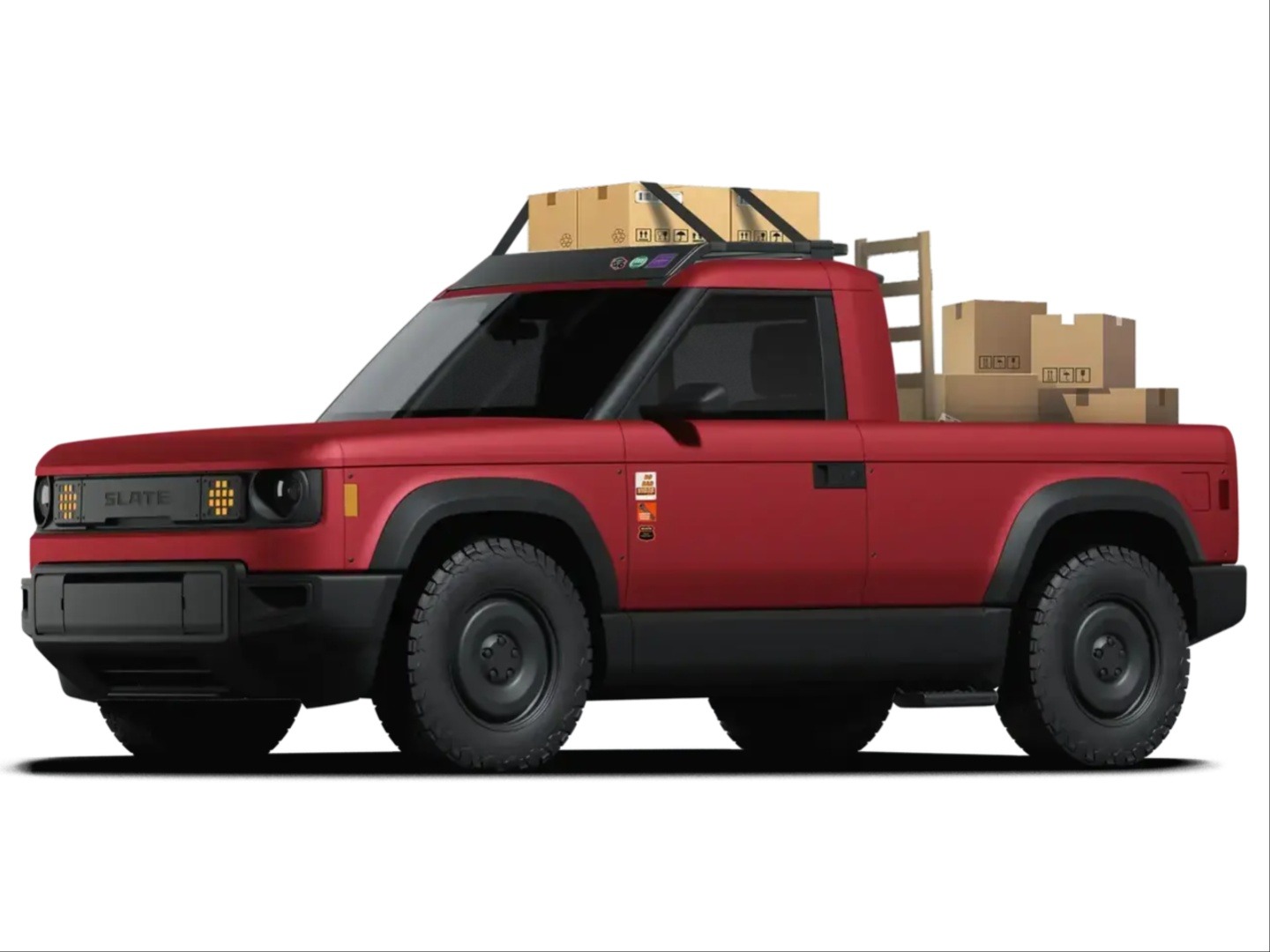
I recently was listening to an episode of the Waveform Podcast where they were discussing the forthcoming Slate pickup. In this clip, the podcasters blithely describe their views of what a small business buyer might want and how well the Slate will serve:
When the Ford F-150 Lightning was introduced, I had the same simplistic view. Here was an electric pickup that looked like a regular truck which, unlike the polarizing Tesla Cybertruck, I thought would be massively attractive to fleet buyers who would value the total cost of ownership advantage of an EV fleet.
Boy was I wrong. Fleet buyers did not flock to the EV F-150, nor did enough consumers and Ford canceled the program recording huge losses in late 2025. Having been proven so wrong, I investigated some of the reasons why fleets have not flocked to EV pickups.
Among the several factors, one is at the top of the list: range reduction due to hauling or towing. When talking about trucks used for work, hauling a load or towing a trailer is a primary requirement. Both an EV and an internal combustion engine (ICE) truck will have reduced range if the truck is carrying a load in the box or towing a trailer. In fact, in percentage terms, the range reduction for an EV and ICE pickup under load is not that different at 10 to 25% for an EV and 10 to 15% for ICE. The problem is that the starting point range for an EV is so much lower. A 25% reduction in range for an EV that may have a best case range of 300 miles brings it down to 225 mi. Whereas a 15% reduction in an ICE vehicle with 500 mile range takes it down to 425 mi. 425 miles should provide plenty of margin in range to cover a day’s shift including traffic delays, reroutes, and so forth. However, a range of 225 mi risks requiring a charge during the work day considering these unknowns.
When it comes to needing a 20-30 minute charge during the workday, the time probably doesn’t mean too much to me as a person who has never worked on the clock. I may get a cup of coffee or read a book. But for a fleet truck owner, the crew in the truck is on the clock during the charge time and is not productive. Wait time that may be an inconvenience for an individual, becomes a significant addition to the cost for a fleet operator.
Another factor that I totally underappreciated are the requirements for electricity for charging in a motor pool yard of any size. To be able to charge an EV pickup overnight, one needs at least a Level 2 charger. This requires 240-volt circuits and 30-40 amps per circuit. Putting one of these in at home to change a single EV may not be a big deal. But if you have 10 or 20 trucks in a motor pool, you are now talking about some major electric utility infrastructure. This is a level of power that few yards would have at the ready because previously there was no need for that much power. So now the fleet buyer is into a requirement for substantial expansion of their utility service which can be expensive and may take a long time for the local utility to deliver.
On top of the capital investment that may be required to provision electricity for charging, the EV trucks so far have carried an upfront price premium compared to ICE trucks. While the 5-year total cost of ownership (TCO) for an EV is likely lower than ICE, the upfront capital premium may be too much for some buyers, especially small and medium business owners. At least on this point, the $25,000 starting price for the blank Slate truck may help. And one last point regarding TCO, large fleet buyers have decades of history with ICE vehicles regarding their reliability history and resale values. This experience allows them to calculate their expected TCO, including anticipated maintenance and repair costs as well as resale value, with much greater precision than for an EV which to-date has much less actuarial experience.
Fleet truck buyers are by necessity practical, economically driven decision makers. Digging into these issues opened my eyes to some of the practical factors. These are real-world factors quite apart from any disposition for or against EVs. The lesson is that EV truck makers need to consider a broad set of factors surrounding the purchase and use of the EV in a fleet and not just the price and specs of the vehicle itself. This is an interesting engineering, economic, and marketing problem to consider.
Let me close by sharing another YouTube clip. This one is from the This Car Pod! podcast in which the hosts energetically describe some other reasons the Slate may have some trouble in the market:
Rod Nelson